Real Results

Performance By The Numbers

Narrow Margins to Confident Execution

Successful Application of MPD Across 11 HPHT, Ultra-HPHT Wells in the North Sea

Objectives

  • Drill narrow-margin sections using a statically underbalanced mud weight (MW) combined with surface backpressure (SBP) to maintain the required overbalance.
  • Manage the drilling window and establish the appropriate tripping mud weight prior to pulling out of hole (POOH).
  • Displace the well to tripping mud, then re-displace to an underbalanced mud weight and circulate out any influx gas before proceeding with managed pressure cementing (MPC).
  • Performed extended flow checks and POOH on elevators while maintaining an adequate swab margin under managed pressure drilling (MPD) control.
  • Run and cement casings and liners using MPC techniques to ensure well integrity and zonal isolation.

Our Approach

  • Implemented detailed pre-well planning and risk assessments to anticipate operational challenges, minimize uncertainty, and ensure smooth execution across all the wells.
  • Used proactive maintenance strategies and robust equipment management practices to prevent bearing failures and reduce the likelihood of unplanned downtime.
  • Fostered strong cross-functional collaboration between drilling engineers, rig crews, and maintenance teams to maintain operational continuity and rapid issue resolution.
  • Employed continuous improvement and lessons-learned reviews between wells, enabling consistent performance gains and the successful delivery of wells.
  • The constant bottomhole pressure (CBHP) variant of MPD was applied throughout the campaign to maintain precise bottomhole pressure control.
  • Dynamic pore pressure tests (DPPT) and dynamic formation integrity tests (DFIT) were conducted during drilling operations to accurately define and validate the operational drilling window.
  • MPD techniques were used to actively manage the drilling window, incorporating DFITs, performing dummy connections, and circulating out gas after tripping back in hole to mitigate temperature-related pressure effects and maintain wellbore stability.

Value to Customer

  • The campaign delivered strong operational performance, with 7 of 11 wells completed with zero nonproductive time (NPT), maximizing productive time and protecting both schedule and budget.
  • Exceptional sealing element performance, with only two early sealing element leaks recorded. In total, 122 sealing elements were deployed, enabling more than 1.36 million ft (414,500 m) to be drilled and stripped through the bearings and sealing elements.
  • The system achieved zero bearing failures over 8,398 operating hours, minimizing mechanical risk and avoiding costly unplanned downtime.
  • The MPD system was fully utilized throughout the campaign, supporting a wide range of applications including high-pressure MPD connections (exceeding 1,000 psi), DFITs, DPPTs, MPD displacements, stripped-out hole operations, injectivity tests, and MPC for both casing and liner strings.
  • Drillpipe was stripped out of the hole at 1.5x the speed of comparable operations, while maintaining required swab margins, enabling the operator to save $100 USD per trip.
  • All bearings provided for the campaign were pre-stabbed onshore and mobilized with crossovers installed. This preparation saved a minimum of 2 rig hours per bearing, resulting in an estimated $2 million USD in overall campaign cost savings.
  • The team successfully executed 13 MPC jobs, further demonstrating operational consistency and MPD capability.
  • Through skilled dedicated personnel, proactive maintenance practices, and robust risk management processes, the campaign established a proven performance benchmark to support future MPD operations.
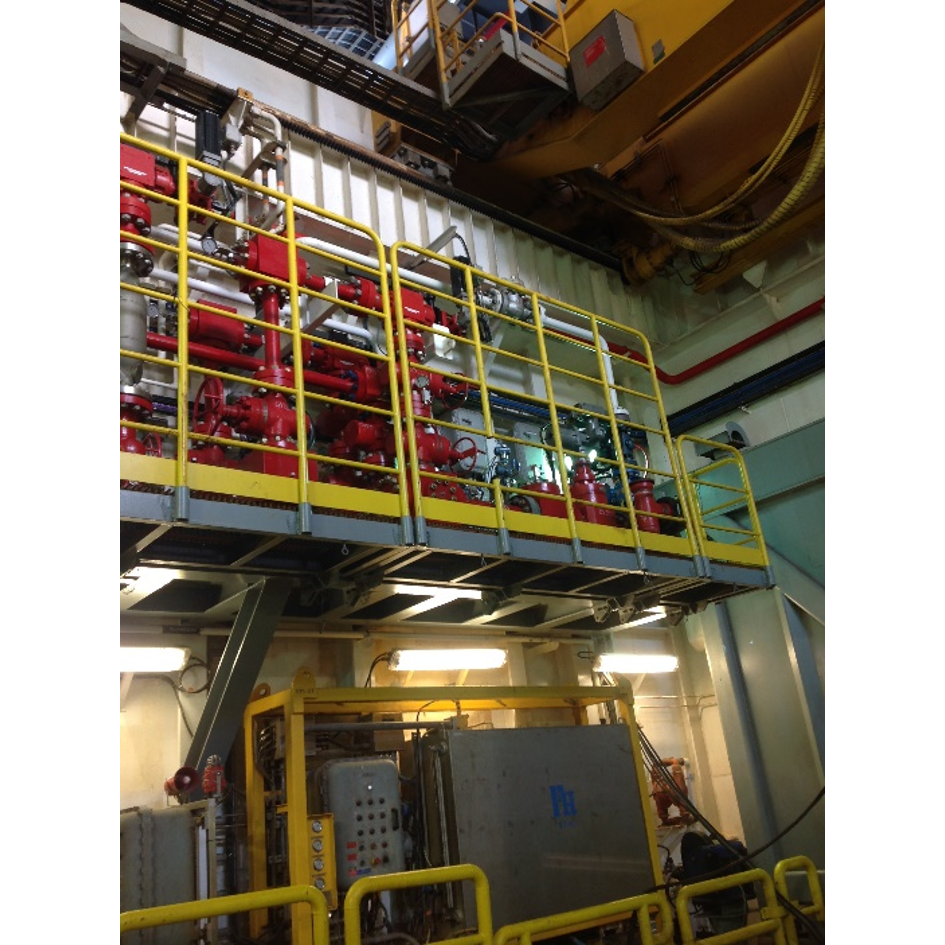
  • The permanently installed MPD manifold and control system allowed the operator to significantly reduce equipment loadout and online rig-up time, ensuring all required equipment remained on the rig. This configuration delivered substantial cost efficiencies by converting recurring mobilization charges into a one-time installation cost.
  • Drill-in-liner operations were also successfully completed. Because the bearing assembly was required to operate outside standard specifications, controlled testing was conducted on a training rig prior to the campaign. The bearing was then successfully operated at 1,750 psi (12 MPa) and 100 rpm on all drill-in-liner applications.
Details

Location

North Sea, United Kingdom

Well Type

Exploration

Formation

Upper Fulmer

Product/Services
Weatherford managed pressure wells solutions

Contact Weatherford

Take the next step in realizing the field of the future. Submit your details and one of our optimization experts will be in touch.