Real Results

Performance By The Numbers

Redefining Operational Excellence

Magnus® RSS Sets New Performance Standard, Reduces Complexity in Gulf of Thailand Drilling

Objectives

  • Drill a development well with zero nonproductive time (NPT).
  • Eliminate a bottomhole assembly (BHA) trip during section drilling.
  • Ensure no tool failures and no service quality issues.
  • Achieve target on-bottom ROP performance: ≥ 131 ft/hr (≥ 40 m/hr) and IADC ≥ 98 ft/hr (≥ 30 m/hr).
  • Deliver the well as per planned profile (excluding FM0 formation).

Our Approach

  • Weatherford experts applied a structured four-phase drilling engineering workflow: design, execution, evaluation, and optimization. This included a comprehensive risk assessment, BHA and parameter optimization based on offset well data, and proactive engagement of the MENA Real-Time Operations Center (RTOC) to ensure operational continuity and risk control.
  • The Weatherford team recommended deploying the Magnus 475 rotary steerable system (RSS) with integrated LWD technologies. This approach replaced the conventional positive displacement motor (PDM) system used in offset wells, directly addressing BHA hang-up issues that previously impeded casing landings.
  • Advanced LWD tools were incorporated to capture real-time and recorded measurements, including temperature, bore/annular pressure, vibration, ECD, gamma ray, near-bit gamma ray, and resistivity. These inputs enabled continuous formation evaluation and proactive drilling parameter adjustments.
  • The RSS drilled from the shoe while maintaining a low dogleg severity (<1°/30 ft [10 m]) to build inclination smoothly. Upon reaching tangent, the system transitioned to autopilot mode, minimizing wellbore tortuosity. Hydraulic modeling guided flow rate and directional control within tool operating limits, while real-time ECD management was achieved through comparison of actual vs. modeled data.
  • The ROP was optimized through real-time parameter management, extending bit life from shoe to section TD and delivering a smoother wellbore. This engineering approach mitigated BHA hang-up risks typical of PDM assemblies, improved casing running efficiency, and ensured a stable, high-performance drilling operation.

Value to Customer

  • Eliminated BHA trip and exceeded ROP targets.
    • The on-bottom ROP of 147 ft/hr (45 m/hr) was 36% higher vs. conventional motor runs.
    • The IADC ROP of 111 ft/hr (34 m/hr) was 43% higher vs. motor runs.
  • The Weatherford solution saved approximately 18 hours by eliminating a BHA trip and approximately 30% overall ROP improvement.
  • The one-run section was completed with no downtime or major issues.
  • Comprehensive engineering planning and risk mitigation ensured smooth operations.
Details

Location

Gulf of Thailand

Well Type

Offshore, J-shape (2D) - Long Tangent

Formation

FM1: Coarse fluvial sandstone, interbedded with shale/mudstone

Hole Size and Angle

6 1/8-in. section, hold tangent 57° inclination (section length: 7,995 ft [2,437m])

Maximum Temperature

302°F (150°C)

Depth

7,219 to 14,416 ft (2,200 to 4,394 m)

Products/Services
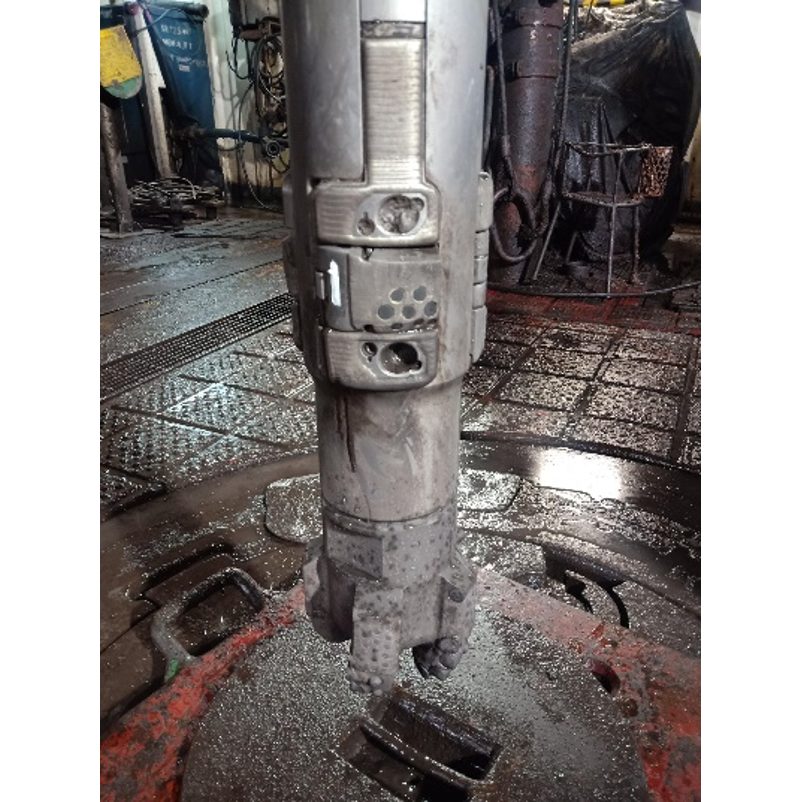
First deployment of the Magnus 475 RSS

Contact Weatherford

Take the next step in realizing the field of the future. Submit your details and one of our optimization experts will be in touch.