Real Results

Performance By The Numbers

When Better Data Drives Better Decisions

Replacing Uncertainty with Measurable Reservoir Insight to Support Long-Term Development Strategy

Objectives

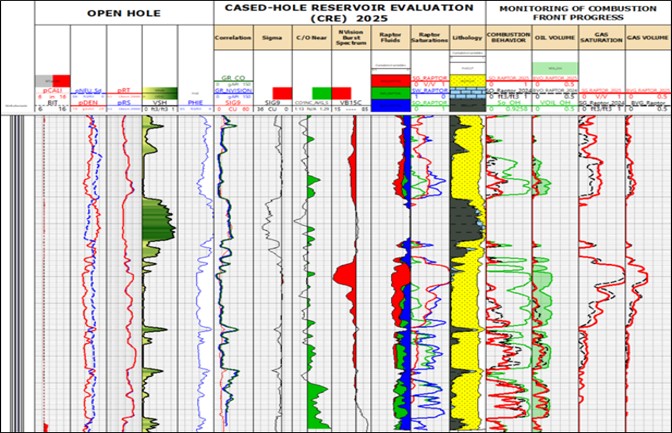
  • Quantify current oil and gas saturations in a cased-hole environment using the Raptor™ 2.0 cased-hole evaluation system processed through N-Vision and carbon/oxygen (C/O) spectroscopic modes.
  • Monitor the in-situ combustion front with high spatial and temporal fidelity by integrating new high-resolution data with legacy openhole logs and the 2024 cased-hole reservoir evaluation baseline.
  • Validate combustion front kinetics and determine whether the front was advancing in line with the thermal-kinetic model.
  • Reduce uncertainty in reservoir behavior and improve confidence for high-value reservoir management and development decisions.
  • Resolve ambiguity around heavy-oil conversion to gaseous phases and confirm the effectiveness of the ongoing in-situ combustion (ISC) pilot to support broader field expansion.

Our Approach

  • Deployed the Raptor 2.0 system in two monitoring wells in the high-resolution N-Vision and C/O acquisition modes, along with integrated pressure and temperature sensors, to diagnose reservoir conditions in extreme thermal environments.
  • Managed very high initial bottomhole temperatures of 450°F (232°C) and 368°F (187°C) through dedicated wellbore recirculation to stabilize temperatures to 256°F (124°C) and 283°F (139°C) for safe logging.
  • Acquired one N-Vision pass and three C/O passes after thermal stabilization to provide the statistical redundancy required for reliable saturation determination.
  • Applied advanced Interpretation and Evaluation Services workflows, including deterministic and stochastic petrophysical processing, to all Raptor 2.0 system-recorded curves and precision pressure and temperature gradients.
  • Integrated the 2025 dataset with historical logs and the 2024 baseline using an envelope-method interpretation workflow to build a multi-year comparative view of front progression and reservoir dynamics.
  • Used Monte Carlo response modeling and VC15 ratios to distinguish hydrocarbon gases such as methane from combustion by-products including carbon dioxide, nitrogen, oxygen, and water vapor.
  • Performed advanced spectral stripping and dry weight closure modeling to assess mineralogical changes in the seal and matrix caused by prolonged thermal exposure.
  • Leveraged the five-detector array of the Raptor 2.0 system to improve gas identification, residual oil saturation evaluation, and time-lapse interpretation in a cased-hole ISC monitoring application.

Value to Customer

  • Confirmed combustion front advancement in both monitored wells with some operational units progressing up to 25% relative to the 2024 baseline.
  • Identified a 7 to 10% increase in gas saturation, validating ISC efficiency in heavy-oil thermal cracking and gasification.
  • Replaced uncertainty with high-quality saturation and front-movement data, giving the operator the technical confidence to guide 2024–2025 reservoir management and workover planning.
  • Demonstrated repeatable, high-temperature performance during the second successful Raptor 2.0 system deployment, with data quality exceeding previous competitor tools.
  • Validated combustion behavior over a full 12-month monitoring cycle, reinforcing confidence in the pilot and supporting future field development expansion.
Details

Location

Colombia

Well Type

Monitoring, directional

Formation

Sandstone, shale

Rig Type

Land workover

Basin

Llanos

Products/Services
Raptor 2.0

Contact Weatherford

Take the next step in realizing the field of the future. Submit your details and one of our optimization experts will be in touch.